I just bought the book called Wheat Belly, written by William Davis, MD. Dr. Davis is a cardiologist in the USA. The book basically describes the effects of wheat on our bodies and the reasons why. He describes how wheat causes a multitude of physical problems primarily related to blood glucose levels. The book also details how wheat started out as an innocent grass that was manipulated by man to create wheat, then in the last fifty years man began to really change the genetic makeup of wheat in an effort to increase yields and decrease losses through disease, drought, insects etc.
While Dr. Davis specialises in wheat all of agriculture has shared the same focus for the last fifty years. Yield per acre is what is considered most important. In the process nutrition and health have been sacrificed. Most people concerned with the issues realise that corn and soybeans, the next two most consumed agricultural products, have gone through the same transitions as wheat. However almost all consumable agricultural products have gone through the same process. Meat production has changed drastically. Our ruminants (cattle, sheep, goats) are being force fed grains to increase growth. Antibiotics and growth hormones are given to increase growth rate. Even the breeds have changed. Angus cattle have increased in size. Other breeds have taken over as the most popular breeds such as Charolais, Limousin, Belgian blue, etc. These are huge animals requiring huge amounts of feed. These cattle are ready for butcher at 12-14 months. Traditional breeds on grass take up to 30 months. Many new breeds carry a mutated gene that causes "double muscling" making the livestock look like body builders. Milk production has gone through the same process. The milk of today is far less nutritious than our grandparents drank. Hog and poultry production has turned into a factory operation where workers where coveralls, breathing and hearing protection. The manure has become a polluting concern. Years ago hogs were raised outside like cattle. Manure was not an issue. Hogs and chickens were raised on grain and garden waist. In fact that was what the hog was for years ago. The first recycler. Any farm waste was fed to the pig and turned into a meat product. Now waste is landfill, adding to our garbage problem. Meat is not the only issue. Vegetables are going through the same issues. Anything is sacrificed in the name of production. Vegetables are fed a steady diet of liquid fertilisers accompanied by a mix fungicides, pesticides and herbicides to decrease disease. Vegetables are picked before being ripe and "chemically ripened" in the back of transports as they are shipped around the world. Tomatoes and peppers are raise in hot houses with their roots bare, not even in soil. The chemists raising and experimenting with these vegetables are arrogant enough to believe they have out smarted mother nature.
Testing done on the products is usually minimal and irrelevant. The tests always seem to favour the new producing product. A large number of tests have been published lately that state organic is no better then conventional production. I do not dought that these same scientist are experts in hydroponics, because they must be smoking something. Something people have to remember is that the companies producing these engineered plants and animals have invested allot of money in their production. They will spend more money to make sure their product is accepted and flourishes. The people growing organically do not have patents on their products. They have no money invested(outside the farm). They also have a much smaller market. The money simply is not their to defend their way of production. The only time we get noticed is when someone like Dr. Davis writes a book that gets attention and gets people talking.
For your own test go to the grocery store and buy some organic and conventional bananas. Do your own taste test. Then tell me there is no difference.
Tuesday, 30 October 2012

Wednesday, 10 October 2012

October has
arrived and the harvest is done for another year. Vegetables have bean picked
and stored in cans or in the cellar, hay is baled and the slow process of
trailering it all home has begun, the grain is off and in the barn. We are
drying seeds from a variety of vegetables to ensure an organic supply for nest
season. The rest of the seeds and supplies for nest season will be ordered in
the nest couple of months. It seems early but to ensure we get what varieties
we want we must order early. We are beginning our marketing plan and
determining prices now for next seasons vegetables.

This summer
has been a trying one on the farm. The worst drought in decades affected our
vegetable, grain, and hay harvests. We only harvested about half the hay we
usually do. But the expense was higher than any other year. This makes for very
expensive hay. Hopefully we have enough. The vegetables faired a little better
because of our organic growing methods. One of which is deep much. The 6+
inches of hay mulch added to the garden did not keep the weeds down, but with
out it the drought would have been devastating. By the third week of July our
soils were drying and our grass was turning brown, but the soil under the mulch
was still damp. The end results were an average year for most of the vegetable
production. As far as the grain is concerned we had a poor yield. The grain was
thin and the grass and clover came up thick making combining the grain
difficult for our old combine. Like the hay our grain yield was at about 50%.
In other
news around the farm, many people read my article in the news paper about the
spraying of herbicides in the forests around our region. The article received a
lot of attention and in the end we were able to stop the use of helicopters to
spray the herbicide close to our property. I even had two forestry
representatives show up at the farm to make a sales pitch about the chemicals
used. Like many of the under educated users of these chemicals they used
personal experience with the chemicals as evidence of the safety. One guy
stated that even had the chemical sprayed right into his mouth and had no ill
effects. What they do not realise is that it is the long term exposure to these
chemicals that cause the problem. Using their argument smoking, alcohol and
most drugs are not hazardous. We all know that one cigarette, beer, or even
hard core drugs will not usually be fatal if only used once. It is long term use
that causes the real problem. The long term effects of the herbicides used are
just now being studied. So far as most people can guess the results are showing
they are NOT safe. The government knows how dangerous most of these chemicals
are. But they turn a blind eye in the name of economics. Just this week
Azinphos-methyl(AZM) a known harmful pesticide was taken out of production. AZM
is a highly neurotoxic insecticide that attacks the human brain and nervous
system. Where would we spray such a dangerous chemical? On our apples, pears,
cherries, bluberries and parsley of course.
Many people
wanted me to continue the fight to ban the use of herbicides in our forests
altogether. Unfortunately this is not an easy fight. Forestry companies,
chemical manufacturers and even the Ontario government support their use. I
simply do not have the time or resources for such a fight. However I would
support any one that takes up the fight. Nova Scotia and BC both have activist
organisations called Stop The Spray. They are dedicated to stopping the use of
herbicides. Their web sites contain a wealth of information on the topic. One
of the biggest issues with our modern day reliance on strong chemicals is the
fact that not everyone reacts the same to them. They may cause prostate cancer
in some, Parkinson’s in others, maybe fertility problems, or allergic reactions
or some other side effect ranging from severe to not so severe. All of which
are not easily measured in a six week study trial. Most of which are paid for
by the chemical manufacturer. Most people do not know that our government does
not study and evaluate every chemical used in our country. Instead they rely on
the chemical manufacturer to pay an independent firm to study the product and
give the results. What decision do you think the independent firm is going to
come up with? Monsanto has already been convicted twice of tampering with the
results of studies done on their products.

In
any case I do not want these chemicals near my property. After reading my article
one of my neighbours called the Nipissing Forest Resource Management office and
asked what effects the chemicals have on wildlife. Their response was that the
wildlife usually leaves the area because the chemical kills off all their food.
However what they fail to realise or tell you is that the chemical takes a
couple weeks to become effective. In that time the deer, moose, rabbits, bears,
etc are all ingesting the chemical laden leaves and berries. My neighbour was
very upset, because they are devoted naturalists. They hunt for many reasons
but one is knowing that the meat they have is clean, chemical free and natural.
Or so they thought.
This blog
is too small to get into all the details about our over reliance on chemicals.
I hope it does spur people into researching the topic themselves. I am content
with the fact that I was able to get the spraying with helicopters stopped in
my vicinity. Especially since I was told just last week that areas close by
were sprayed this summer and they missed their target. Instead they sprayed the
front yards of the rural homes.
So the
winter wind down has begun and I will be able to spend more time on the blog
and creating our new website. After I haul the hay home, spread the manure,
plow the fields,…I though winter was supposed to be slow on a farm.
For anyone
interested our winter meat box prices and details will be going out this week.
As well as information on our 2013 vegetable CSA program. Anyone signing up
before December will get a discount. People that sign up early allow us to make
sure we can order and pay for supplies that we will need for next season.
Friday, 7 September 2012
Organic vegetable nutrition
Vegetable harvest is in full swing now. Tomatoes, potatoes, peppers, beans, peas, even the pumpkins are ready for harvest. Now that Lynn and I are in vegetable mode we are very excited. Our CSA program has been a success, vegetables are looking good despite the drought this summer which did effect some of our harvest but most have recovered. We plan on expanding our CSA membership to 20 full time members next year.
While researching some information for our marketing efforts for next year we have run across many articles which reference a recent study published in The Journal of Science of Nutrition and Agriculture. The article states that their research indicates little to no nutritional benefits or difference between organic and conventional produced vegetables. The problem with these "scientific" studies are that they are conducted by scientist, who tend to be biased. The fact is that they believe they know all there is to know. For instance when the scientist research what chemicals need to be in a fertiliser for tomatoes, they typically decide on nitrogen, phosphorus, and potassium levels. These three elements are generally recognised as the ingredients in chemical fertiliser. However we all know that plants require much more than these three elements.
The problem with conducting studies such as the one mentioned is the journal is that there are so many variables. For instance many large companies have jumped on the organic bandwagon. Large companies have bastardised the organic industry by bending and twisting the organic standards in an effort to capitalise on the increased prises and niche market created by the organic industry. While all farmers are in business to make a profit, some are more relentless than others. In general smaller organic family farms concentrate on plant health and the quality of their product. This added effort is represented in the higher prices most organic vegetables demand. Big business capitalises on the higher prises, but often use conventional farming practises that have been modified to meet organic standards.
Additionally the "scientific" studies do not measure the entire chemical makeup of the vegetables. While common vitamin and mineral levels are measured, photo chemicals are not. These are compounds that are not vitamin or mineral that are believed to contribute to our health. Photo chemicals effect the taste and colour of fruits and vegetables. They also help fight off disease in the plant. Much can be changed about the nutritional value of a plant by its environment. Small organic farmers use green manures and animal manures for fertilisers. Making the soil more diverse and nutritious for the plant. This nutrition is passed on to the final consumer. Large scale industrial type organic farms use "natural" fertilisers such ad alfalfa meal, soy meal, blood, bone meal or corn gluten meal. All of these chemicals are approved for organic production. They represent a poor attempt at copying the conventional vegetable production. I should mention that I am not against using these products, however they should be used as amendments to the soil, not as primary means of fertilisation and plant nutrition. They are still better that adding oil derived fertilisers like the conventional vegetable producers use.
This brings us to the next point. Something that is not mentioned, is what is not in the organic vegetables. Chemical residues from commercial fertilisers, pesticides, hormones and antibiotic residues form commercial manure applications. As well there are chemicals that are added for chemical ripening, or preserving fruit and vegetables. None of these chemicals have had adequate testing to see what the long term health effects are on humans or our environment.
An article published in mother earth news 10 years ago is probably more accurate that the studies published now. 10 years ago organic produce was not being bombarded by the commercial industry like it is now. While I can not remember off hand the exact numbers in the study it basically stated that, when a conventionally grown tomato from a grocery store was compared to an organically grown tomato grown in composted manure, the latter had over 300% the micro nutrients.
How do you know what to eat. Its simple, find a farmer you can trust and eat as seasonally as you can. Organic certification only means that the farmer meets the organic standards. It does not mean they have to be ethical about it.
While researching some information for our marketing efforts for next year we have run across many articles which reference a recent study published in The Journal of Science of Nutrition and Agriculture. The article states that their research indicates little to no nutritional benefits or difference between organic and conventional produced vegetables. The problem with these "scientific" studies are that they are conducted by scientist, who tend to be biased. The fact is that they believe they know all there is to know. For instance when the scientist research what chemicals need to be in a fertiliser for tomatoes, they typically decide on nitrogen, phosphorus, and potassium levels. These three elements are generally recognised as the ingredients in chemical fertiliser. However we all know that plants require much more than these three elements.
The problem with conducting studies such as the one mentioned is the journal is that there are so many variables. For instance many large companies have jumped on the organic bandwagon. Large companies have bastardised the organic industry by bending and twisting the organic standards in an effort to capitalise on the increased prises and niche market created by the organic industry. While all farmers are in business to make a profit, some are more relentless than others. In general smaller organic family farms concentrate on plant health and the quality of their product. This added effort is represented in the higher prices most organic vegetables demand. Big business capitalises on the higher prises, but often use conventional farming practises that have been modified to meet organic standards.
Additionally the "scientific" studies do not measure the entire chemical makeup of the vegetables. While common vitamin and mineral levels are measured, photo chemicals are not. These are compounds that are not vitamin or mineral that are believed to contribute to our health. Photo chemicals effect the taste and colour of fruits and vegetables. They also help fight off disease in the plant. Much can be changed about the nutritional value of a plant by its environment. Small organic farmers use green manures and animal manures for fertilisers. Making the soil more diverse and nutritious for the plant. This nutrition is passed on to the final consumer. Large scale industrial type organic farms use "natural" fertilisers such ad alfalfa meal, soy meal, blood, bone meal or corn gluten meal. All of these chemicals are approved for organic production. They represent a poor attempt at copying the conventional vegetable production. I should mention that I am not against using these products, however they should be used as amendments to the soil, not as primary means of fertilisation and plant nutrition. They are still better that adding oil derived fertilisers like the conventional vegetable producers use.
This brings us to the next point. Something that is not mentioned, is what is not in the organic vegetables. Chemical residues from commercial fertilisers, pesticides, hormones and antibiotic residues form commercial manure applications. As well there are chemicals that are added for chemical ripening, or preserving fruit and vegetables. None of these chemicals have had adequate testing to see what the long term health effects are on humans or our environment.
An article published in mother earth news 10 years ago is probably more accurate that the studies published now. 10 years ago organic produce was not being bombarded by the commercial industry like it is now. While I can not remember off hand the exact numbers in the study it basically stated that, when a conventionally grown tomato from a grocery store was compared to an organically grown tomato grown in composted manure, the latter had over 300% the micro nutrients.
How do you know what to eat. Its simple, find a farmer you can trust and eat as seasonally as you can. Organic certification only means that the farmer meets the organic standards. It does not mean they have to be ethical about it.
Tuesday, 14 August 2012
Summers passing us by
July flew past us between haying, gardening and our unexpected trip to Sick Kids with Allison. Allison is doing great and is pretty much back to normal. She is still taking it easy just to make sure. Another event that took place during the last month was a confrontation with the Nipissing Forest Resource Management. Many people have called, emailed and even showed up at the farmers market to express their support. We received a letter stating that the NFRM would be aerial spraying herbicides in an area close to our farm. They spray the chemicals to kill all broad leaf plants, giving coniferous trees such as spruce and pine an advantage. As you can imagine the letter did not impress me and really upset Lynn. In response to the letter I sent an email to NFRM, our MPP, The Green Party, and the Nipissing News. My letter basically expressed my concerns including the concern that our government is pouring known carcinogens into our forests. Our MPPs office was very helpful, so was the Nipissing News, who published my letter. They also wrote their own article after interviewing me. The result is that the NFRM will no longer be spraying with helecopters. Instead they will use skidders. A skidder is a large tractor that is used for hauling logs out of the bush to a landing site. I made sure to express in my interview that I am not against logging. In fact done properly I think it is sustainable industry. My major concern is the spraying of toxic chemicals into our environment. The main chemical used is called Virox Max. Virox Max is basically the same as Round up. If fact they are manufactured by the same company, Monsanto. Yes the psychopathic company Monsanto. Producer of PCB, Agent Orange, synthetic bovine growth hormones and most genetically modified plants. I did not know much about Virox Max, I do now, but I do know a bit about Roundup. My personal opinion is that Round up is a dangerous chemical for a variety of reasons. First of all the health hazards. Monsanto would have us believe it is perfectly safe. However independent studies are proving otherwise. I won't go into great detail but glyphosate affects hormone production. Messing with hormones can cause a variety of disease, not the least of which is cancer. Monsanto has already been convicted twice of falsifying results of an "independent" study. I found it ironic that even after the convictions Canada did not do any testing of these products. They rely on independent studies paid for by the producing company. Glyphosate is extremely deadly to frogs and amphibians, which in turn are food for a large variety of wildlife. The use af glyphosate in the forest destroys the natural habitat and food supply for moose, bear, deer, rabbit and a variety of other animals. It also causes mono cultures of coniferous trees. We all saw what that can do this summer with the forest fires in Northern Ontario. Coniferous trees are far more flammable than deciduous tree. Mono cultures can also be devastated by disease. We are all ready seeing this problem with the red and white pine trees.
Wednesday, 25 July 2012
Hay and Horses
We had to take a week off of haying for a trip Sick Kids in Toronto. Allison was injured while working with her new horse. We are not sure what exactly happened, but some how the horse was spooked and reared up. From what we understand the horse then fell on Allison. When a horse falls or goes down in any way they panic to get up on their feet.Some how during the event Allison sustained a blow to the side of her head from a hoof. We ended up very lucky and Allison is doing fine now. However after a suspencful week Allison did end up with 6 stitches and a small fracture. The girls usually wear helmets for riding, but it is clear they need them whenever they work with the horses. Allsion is now "grounded" for the summer. Doctor's orders. No horses, no heavy lifting, no bike riding, no swimming for 8 weeks.
 |
| Allison has been bugging to help with hay all year. Here she is raking the hay so I can bale it for her horses, before the accident. |
Wednesday, 13 June 2012
New additions
Some new additions arrived on the farm this week. On Monday Lynn and I made a trip to a livestock auction to purchase some more stocker calves to finish for this winter. Demand for our beef far exceeds the number of calves that our cattle produce. We usually purchase weaned calves and raise them on our farm until they are old enough to process. However calf prices are extremely high, approximately 2 times what we paid last year. At that price we can not finish the beef and market it at a reasonable price. Our beef sales may have to change to reflect the lower than usual number of calves we will be raising.
 On a "positive" note. There were other creature that were reasonably prices. I can tell you now there is a good chance I will be winning father of the year after bringing home these two "pets". The girls were and still are very excited about the new additions. The Appaloosa is a 16 month old gelding and the bay coloured is an 8 month old filly. Very affectionate little fellows. The girls will be responsible for basic obedience training over the next year. The horses cannot be ridden until they are 2.5-3 years old. But training starts now.
 We are not really horse people. Horse people can be pretty extreme. However we do enjoy horses. Unlike other livestock they can have a genuine affection for their caretakers. Sheep, cattle, pigs, chicken, etc. only really care that you bring food. The gelding was afraid of the trailer while. So after several attempts and praise and petting, I could tell he was not sure about the trailer. While stroking his neck and telling him it would be OK, he leaned into me placing his head against my chest. If horses could hug that was one. He eventually loaded and was fine on the trip home.
 Lynn's Polish hen decided it was time to be a mother hen. A Polish hen is a funny looking thing. They are the only white egg layers we have. It takes 21 days of dedication from the hen to sit on eggs in order to hatch them out. Several chickens share a nest box, so we don't know who actually laid the eggs that this girl hatched. We collect our eggs on a daily basis, but ever once and a while the hens find a new hiding spot. These guys were hatched out in the wall of the barn.
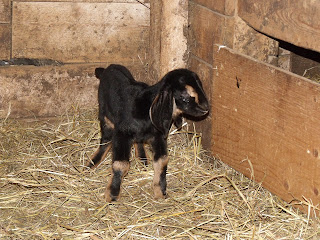 We keep a few goats, I am not sure why because they can be a real handful. This little girl was born this week and looks to be in good health. when we have more time, such as through the winter we like to milk the goats. They provide excellent milk that is far more nutritious than the watered down, broken down stuff you buy in the store. Goat milk is much easier to digest then cow milk because of the different sugars (lactose) and the fat globules are smaller making them easier to digest. Goats are one of the other animals on the farm that has a personality. But that is not always a good thing.

 We are not really horse people. Horse people can be pretty extreme. However we do enjoy horses. Unlike other livestock they can have a genuine affection for their caretakers. Sheep, cattle, pigs, chicken, etc. only really care that you bring food. The gelding was afraid of the trailer while. So after several attempts and praise and petting, I could tell he was not sure about the trailer. While stroking his neck and telling him it would be OK, he leaned into me placing his head against my chest. If horses could hug that was one. He eventually loaded and was fine on the trip home.
  Lynn's Polish hen decided it was time to be a mother hen. A Polish hen is a funny looking thing. They are the only white egg layers we have. It takes 21 days of dedication from the hen to sit on eggs in order to hatch them out. Several chickens share a nest box, so we don't know who actually laid the eggs that this girl hatched. We collect our eggs on a daily basis, but ever once and a while the hens find a new hiding spot. These guys were hatched out in the wall of the barn.
 We keep a few goats, I am not sure why because they can be a real handful. This little girl was born this week and looks to be in good health. when we have more time, such as through the winter we like to milk the goats. They provide excellent milk that is far more nutritious than the watered down, broken down stuff you buy in the store. Goat milk is much easier to digest then cow milk because of the different sugars (lactose) and the fat globules are smaller making them easier to digest. Goats are one of the other animals on the farm that has a personality. But that is not always a good thing.
 Guard duty
 Jack and Jill standing guard.Luckily for everyone we have not seen or heard any coyotes or wolves since winter. The odd fox comes around at night, but they know better then to cross the fence. The sheep are enjoying the pasture and the lambs look great so far. Our flock (as well as approximately 90% of all Ontario flocks) have been plagued by foot rot. Foot rot is an infection caused by the combination of two bacteria. It can cause discomfort for the sheep and effects the performance of the lambs. If left untreated it can lead to more serious problems. One of the bacteria is found in almost all soils, the other is usually imported when an infected sheep is purchased. The infection is a major issue across Canada and around the world. It can be very difficult to cure, especially here where
the climate is humid. However through much research and and planning we think we have effectively cured our flock. All without the use of antibiotics. Antibiotics are only moderately effective as treatment because the bacteria live on the hooves of the sheep for months, hiding in any cracks or crevices. The bacteria can also survive in the environment for weeks. We are anxiously watching the flock for signs of infection, but have been infection free now for two months. If all goes well we will start marketing our ideas to other sheep farmers. Spring is usually the worst time for foot rot.

Subscribe to:
Posts (Atom)